The industry talks about "AI-native" software like it's a feature checkbox. Add a chatbot. Bolt on some automation. Ship it.
Most B2B SaaS remains fundamentally static-screens, buttons, fixed features, one-size-fits-all. The same platform is supposed to serve a single-host vacation rental operator in Austin and a 500-unit enterprise managing long-term, mid-term, and short-term across three continents. It can't. No amount of AI chatbots will fix that.
The Frankensoftware Problem
Mature B2B SaaS in short-term rentals exhibits infinite sidebars, fifteen pages within single sections, nested sidebars, and features consuming screen real estate users never need. Workflow builders require PhD-level configuration. With AI, complexity multiplies: more configurations, more toggles, more buried "AI settings."
Onboarding takes months-not because operators are slow, but because "the software is bloated with features designed for every possible use case, which means it's optimized for none of them." AI was supposed to simplify software. Instead, vendors "are using it to add complexity. More buttons. More options. More cognitive load."
The Diversity Problem
Property managers aren't monolithic. The category includes vacation rental operators versus long-term managers versus hybrid portfolios; single hosts versus virtual property managers versus multi-brand enterprises; offshore teams versus in-house operations versus fully outsourced models; operators with 5 units versus operators with 500.
Each has fundamentally different needs, workflows, reporting requirements, team structures, and integrations. A single static software cannot serve all. "One-size-fits-all means nothing-fits-anyone."
Data silos exist because when one platform solves only a narrow slice of needs, operators duct-tape five platforms together-each "best in class" at something, none communicating.
The Trellis Model
The future isn't smarter static software. It's "software that grows around you."
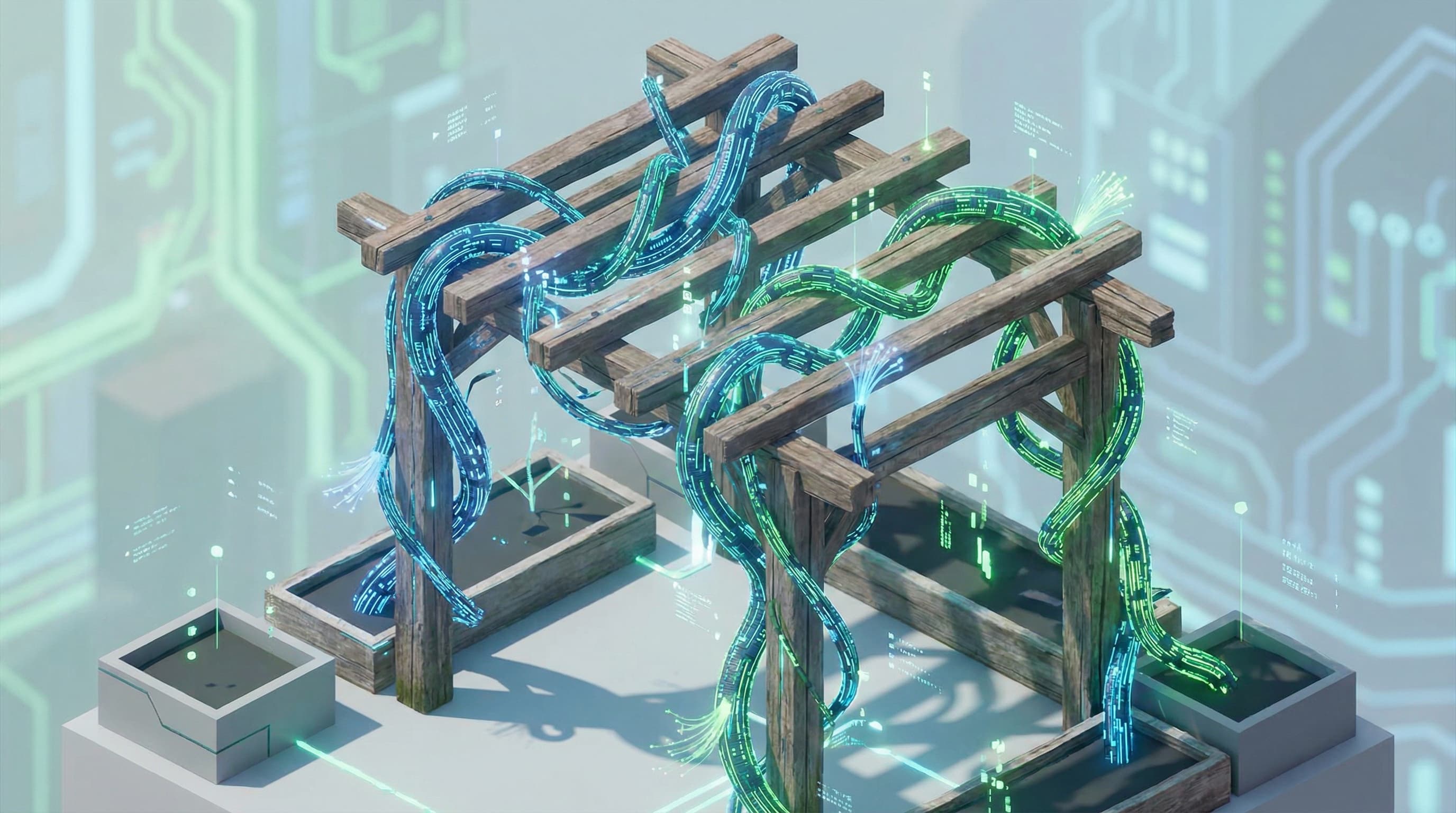
Think of a trellis and vine. The vendor provides the trellis: fixed infrastructure. AI grows the vines: dynamic features, workflows, and interfaces adapting to each customer's specific needs.
The trellis (fixed infrastructure) includes:
- Core systems: orchestration engine, workflow execution, AI learning and memory
- Communication and operations: unified inbox, dispatching algorithms, task management, workforce coordination
The vines (dynamic layer) include:
- Business logic: policies, custom workflows, AI behavior and teachings
- User interfaces and connections: vendor portals, cleaning team interfaces, reporting dashboards, integrations and data connections
The trellis stays constant. The vines grow differently for every operator based on their context, scale, and operational model.
The Death of the Changelog
Traditional B2B SaaS is dying.
The old model: vendors ship features, everyone gets the same update, customers adapt. One changelog for all customers.
The new model: "one changelog per client, not per company."
Each customer's software evolves independently. Operators don't submit feature requests and wait six months. They tell the AI what they need, and "the software adapts. New workflow? Built. Custom report? Generated. Bespoke integration? Connected."
"The software grows around the business, not the other way around."
What Happens to Product Teams?
If customers build their own features through AI, what remains for software companies?
Product managers shift from designing features to designing capabilities. They observe what custom solutions customers build and abstract common patterns into reusable modules. "They're not shipping buttons; they're shipping building blocks that AI can assemble."
"The AI agent becomes the forward deployed engineer in your customers' systems. It works directly with each operator, builds bespoke solutions, and feeds patterns back to the product team for abstraction."
Adaptive UI: The Screen Disappears
The entire concept of fixed screens becomes obsolete.
In trellis software, "UI is assembled at runtime based on what the user needs to accomplish. Not pre-built pages. Not static dashboards. The AI determines what context the user needs to make a decision and presents it in the optimal format."
Example: Asking AI to plan today's maintenance routes. Traditional software delivers a text list or basic calendar view. Adaptive UI provides "an interactive map with routes plotted for each team member, drag-and-drop rescheduling, and real-time updates as you make changes. The interface materializes around the task."
This represents a shift from systems of record to "systems of action. The software doesn't just store information. It surfaces exactly what you need, when you need it, in the format that enables action."
Three Signals for Evaluation
If evaluating software today, these signals distinguish genuine trellis architecture from legacy software with an AI wrapper:
1. Can you interact with every part of the app through an agent? If you can only chat with AI in one section while the rest requires menu clicking, it's not AI-native.
2. Can you build and customize your own features? Not just "configure settings." Actually build new workflows, reports, and data structures without waiting for the vendor's roadmap.
3. Is the UI dynamically generated? Does the interface adapt to your specific context and task, or are you navigating the same static screens as every other customer?
"If the answer to any of these is no, you're looking at legacy software with a chatbot taped on top."
The Bottom Line
Can existing software companies make this shift? Probably not. "You can bolt AI onto legacy systems, but you can't retrofit a trellis onto a monolith."
Trellis-native software compounds. Every customer is a builder. Every custom workflow becomes a reusable module. Every interaction teaches the system. While legacy vendors ship one feature at a time to all customers, trellis software grows thousands of features simultaneously, all feeding back into the core.
"The vines start small. Then they wrap around the old infrastructure. Then they squeeze. By the time incumbents notice, they're already suffocating."
Related reading: The Great 2026 Consolidation dives into why 15-tool tech stacks are dying, and The Future of Hospitality looks at who wins the next decade.
