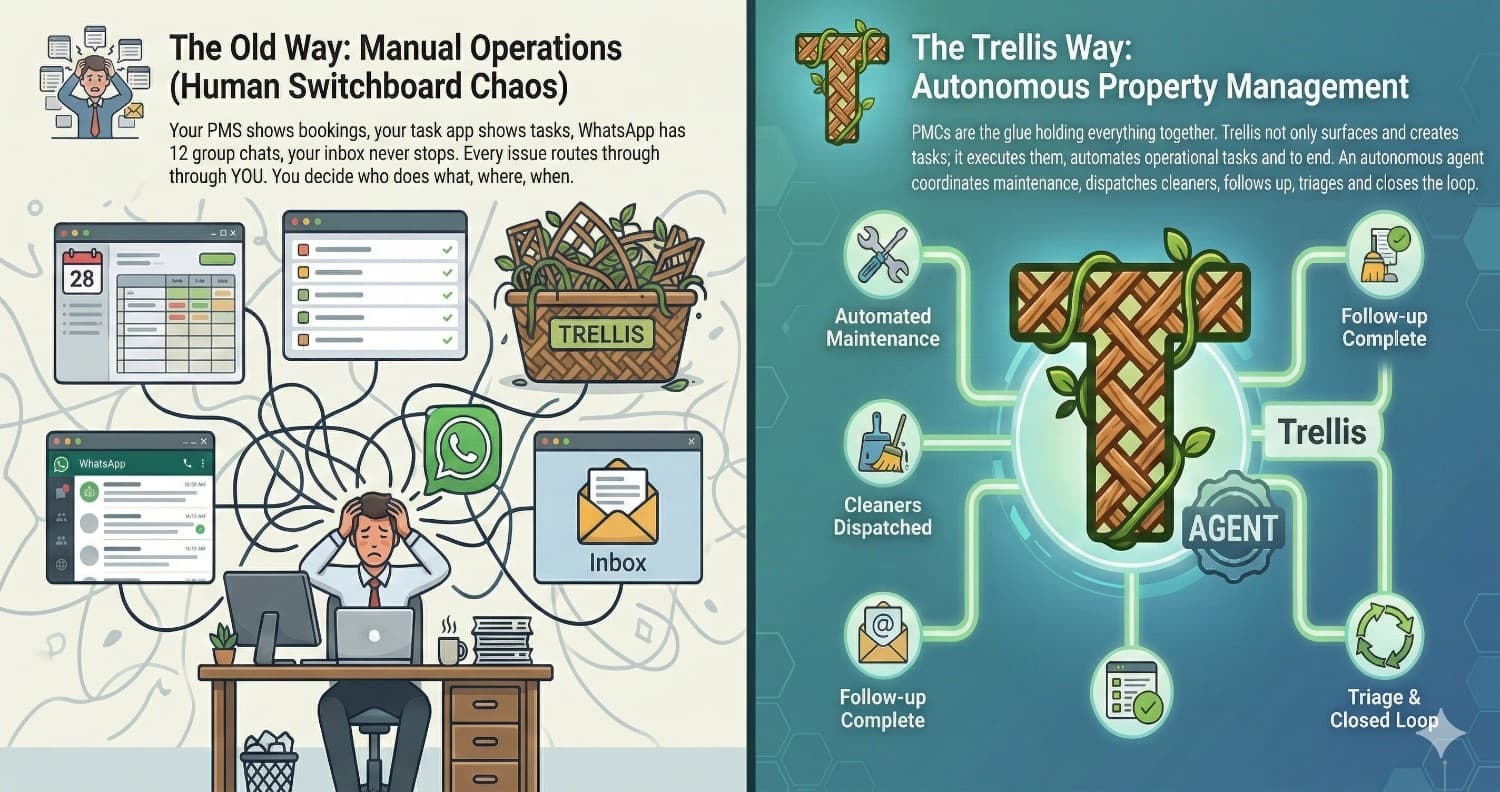
Most short-term rental operators start the same way: a spreadsheet for cleaning schedules, a WhatsApp group for vendor coordination, and a phone that never stops buzzing. It works - until it doesn't.
This comparison breaks down the real differences between running operations manually and automating them with Trellis.
The Manual Approach
Manual operations typically involve:
- Spreadsheets for tracking cleaning schedules, turnovers, and maintenance logs
- Group chats (WhatsApp, SMS, iMessage) for coordinating with cleaners, handymen, and co-hosts
- Phone calls for urgent issues - a broken AC, a guest locked out, a plumbing emergency
- Email threads for vendor invoices, guest follow-ups, and owner reports
- Mental load - the operator remembers which vendor handles which property, which cleaner is available on Thursdays, which guest needs a late checkout
This approach is free (in terms of software costs), familiar, and flexible. It's also the reason most operators plateau at 15–25 units.
Where Manual Operations Break
1. Communication Gaps
When a guest reports a broken dishwasher at 10 PM, the manual workflow looks like this:
- Operator reads the message
- Operator texts the maintenance vendor
- Vendor responds (maybe tomorrow morning)
- Operator relays the update to the guest
- Vendor fixes the issue (or doesn't)
- Operator follows up with the vendor
- Operator updates the guest
- Operator logs the issue somewhere (maybe)
That's 8 steps, all dependent on the operator being available and remembering to follow up. Multiply this by 20 properties and 3 issues per week, and it becomes clear why operators burn out.
2. No Closed Loops
Manual operations have no built-in verification. Did the cleaner actually finish the turnover? Did the handyman show up? Was the guest satisfied with the resolution? Without a system that closes the loop, operators rely on trust - and trust doesn't scale.
3. Knowledge Lives in One Person's Head
If you're the operator, you are the system. Your cleaners text you. Your vendors call you. Your guests message you. There's no process documentation, no escalation path, no backup. If you're sick, on vacation, or just asleep - operations stall.
4. Growth Multiplies Complexity
Going from 10 to 30 units doesn't mean 3x the work. It means 3x the vendors, 3x the guest issues, 3x the cleaning schedules - with exponentially more coordination required between them. Manual operations scale linearly at best. Complexity scales exponentially.
The Trellis Approach
Trellis replaces the operator-as-switchboard model with automated coordination:
Cleaning & Turnovers
- Trellis automatically schedules cleaners based on checkout/checkin times from your PMS
- Assigns the right cleaner based on property, availability, and workload
- Sends task details with property-specific checklists
- Verifies completion and flags issues before the next guest arrives
Maintenance Dispatch
- Guest reports an issue → Trellis triages it automatically
- Dispatches the right vendor based on issue type, property location, and vendor roster
- Coordinates scheduling between guest and vendor
- Follows up until the issue is verified resolved
- Logs everything for owner reporting
Guest Communication
- Trellis handles routine guest messages (check-in instructions, house rules, local recommendations)
- Escalates complex issues to the operator only when needed
- Keeps the guest updated throughout issue resolution - without the operator copying and pasting between apps
Vendor Coordination
- Centralized vendor roster with specialties, availability, and performance tracking
- Automatic task assignment and follow-up
- No more chasing vendors through text threads
Head-to-Head Comparison
Response Time
- Manual: Depends on when the operator sees the message. Could be minutes, could be hours.
- Trellis: Immediate. Automated triage and dispatch happen in real time.
Issue Resolution
- Manual: Operator must manually coordinate between guest, vendor, and follow-up. Average resolution: 24–48 hours for non-urgent issues.
- Trellis: End-to-end automated coordination. Average resolution time drops significantly because no step depends on the operator remembering to follow up.
Scaling
- Manual: Each new property adds proportional (or more) coordination overhead. Most operators hit a ceiling at 15–25 units without hiring.
- Trellis: Coordination overhead stays flat. Adding properties doesn't require adding staff for operational coordination.
Cost
- Manual: Low software cost, but high hidden cost - operator time, missed issues, guest complaints, lost reviews.
- Trellis: Monthly subscription, but recaptures 15–25 hours per week of operator time and reduces costly operational failures.
Reliability
- Manual: Single point of failure (the operator). No redundancy, no audit trail.
- Trellis: Automated workflows run 24/7. Full audit trail. Nothing falls through the cracks.
Who Should Stay Manual?
If you manage 1–5 properties as a side project, manual operations might be fine. The coordination load is manageable, the stakes are lower, and the cost of automation may not justify the investment.
Who Should Switch to Trellis?
If you manage 10+ units and spend more time coordinating than growing - scheduling cleaners, chasing vendors, copying guest messages between apps - you've outgrown manual operations. The question isn't whether to automate. It's how much longer you can afford not to.
The Bottom Line
Manual operations aren't a strategy. They're the absence of one. They work at small scale because the operator can hold everything in their head. But the moment you want to grow - or just stop working 70-hour weeks - you need a system that coordinates without you in the middle.
Trellis is that system. It doesn't just organize your operations. It runs them.
Ready to see how Trellis handles your operations? Book a demo and we'll walk you through it with your actual portfolio.
