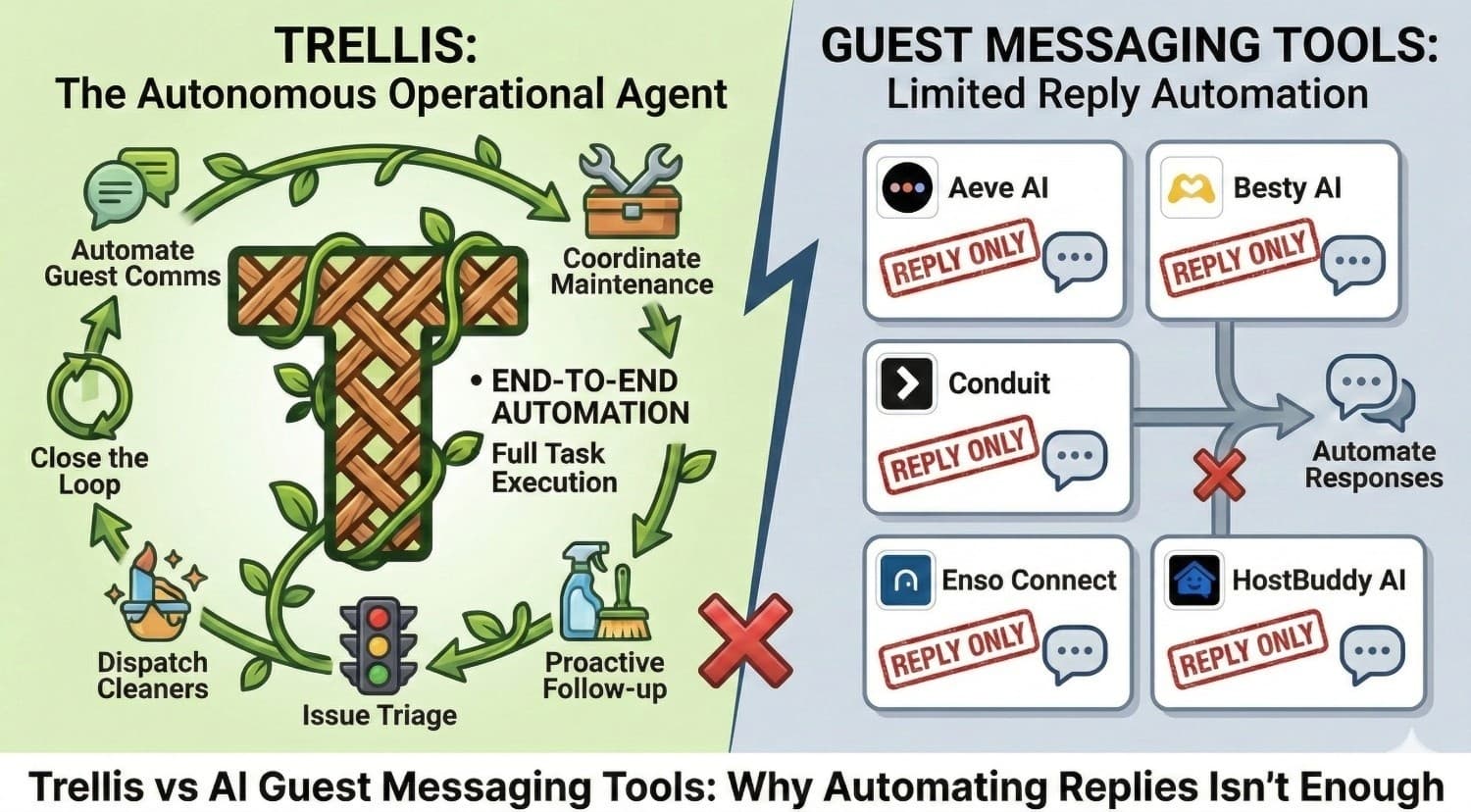
Over the past two years, AI guest messaging tools have become one of the most popular categories in short-term rental tech. Tools like Aeve.ai, Besty AI, Conduit, Enso Connect, Hostbuddy and other chatbot-style platforms promise to handle guest communications automatically.
They deliver on that promise - for the messaging layer. But messaging is only the visible surface of operations. Behind every automated reply is a coordination workflow that these tools don't touch.
This comparison explains the difference between automating guest replies and automating the operations they trigger.
What AI Guest Messaging Tools Do
AI messaging platforms focus on one thing: responding to guests automatically. They typically offer:
- Automated responses to common guest questions (check-in time, WiFi password, parking instructions)
- AI-generated replies for more complex messages, using property data and conversation context
- Saved templates and message scheduling
- Multi-channel support (Airbnb, VRBO, direct booking, email, SMS)
- Escalation rules for messages the AI can't handle
For routine communication - pre-arrival info, house rules, local recommendations - these tools work well. They reduce response time and free the operator from answering the same questions repeatedly.
Where Messaging Automation Stops
The limitation becomes clear the moment a guest message requires action, not just a reply.
Example: "The AC isn't working"
What an AI messaging tool does:
- Detects the issue
- Sends an empathetic response: "We're sorry to hear that! We'll look into this right away."
- Alerts the operator
What still needs to happen (manually):
- Operator triages the issue
- Operator contacts the HVAC vendor
- Vendor confirms availability
- Operator coordinates a time that works for the guest
- Vendor arrives and fixes (or doesn't fix) the issue
- Operator follows up with the vendor
- Operator updates the guest
- Operator logs the resolution
The AI messaging tool handled step 1–3. The operator still handled steps 4–8. And those are the steps that actually take time - the coordination, follow-up, and resolution.
Example: "We need more towels"
AI messaging tool: "Of course! We'll arrange that for you."
What happens next: The operator texts the cleaner, hopes they see it, follows up if they don't, and eventually confirms with the guest. The AI wrote a nice message. The operator did the work.
Example: Guest checks out, turnover begins
AI messaging tool: Sends the guest a checkout reminder and a review request.
What actually needs to happen: The cleaning team needs to be dispatched, the property needs to be inspected, the next guest's early check-in request needs to be evaluated against the cleaning timeline, and any maintenance issues found during turnover need to be addressed before the next arrival.
None of that is messaging. It's coordination.
What Trellis Does Differently
Trellis doesn't replace AI guest messaging - it completes the workflow that messaging starts.
From Reply to Resolution
When a guest reports an issue through any channel, Trellis doesn't just respond. It:
- Triages the issue - determines urgency, type, and the right vendor
- Dispatches automatically - contacts the vendor from your roster, shares the issue details
- Coordinates scheduling - works out timing between guest availability and vendor access
- Follows up - if the vendor hasn't responded, Trellis escalates or reassigns
- Verifies completion - confirms the issue is resolved before closing the loop
- Updates the guest - keeps them informed throughout, not just at the start
Cleaning Coordination
AI messaging tools don't schedule cleaners. Trellis does:
- Auto-assigns based on checkout/check-in times, cleaner availability, and property match
- Sends property-specific checklists
- Tracks completion in real time
- Flags delays before they impact the next guest
Vendor Management
AI messaging tools don't manage vendors. Trellis does:
- Maintains a centralized vendor roster with specialties and availability
- Routes issues to the right vendor automatically
- Tracks vendor response times and resolution rates
- Handles follow-ups and escalations without operator involvement
Key Differences
Scope of Automation
- AI Messaging Tools: Automate the conversation layer - what you say to guests.
- Trellis: Automates the operational layer - what happens after you say it.
Operator Time Saved
- AI Messaging Tools: Save time on drafting and sending messages. Operators still handle all coordination behind those messages.
- Trellis: Eliminates the coordination entirely. Operators only get involved for true exceptions.
Scaling Impact
- AI Messaging Tools: Reduce response time as you scale. Operational burden still grows with each new property.
- Trellis: Operational coordination stays flat regardless of portfolio size. Adding properties doesn't add proportional work.
Integration Depth
- AI Messaging Tools: Connect to messaging channels (Airbnb, VRBO, SMS, email).
- Trellis: Connects messaging channels to your PMS, vendor roster, cleaning teams, and maintenance workflows - creating a single automated system.
Do You Need Both?
You might. AI messaging tools and Trellis solve different layers of the same problem.
If your primary pain point is response time and guest satisfaction scores, an AI messaging tool is a good starting point. It handles the visible layer.
If your primary pain point is coordination - the hours spent dispatching vendors, following up with cleaners, bridging between guest messages and actual resolution - Trellis is what you need. It handles the layer beneath.
For operators managing 20+ units, the combination of both creates a fully automated operation: AI handles the guest-facing conversation, Trellis handles everything behind it.
But if you had to choose one, ask yourself: Is your bottleneck writing messages, or doing the work those messages create?
For most operators at scale, the answer is the work.
The Bottom Line
AI guest messaging tools solved the first problem: responding to guests quickly. They're useful, and they've raised the bar for guest communication across the industry.
But they left the harder problem untouched: the operational coordination that happens after every message. The dispatching, the follow-ups, the scheduling, the verification, the loop-closing.
That's what Trellis automates. Not the reply - the resolution.
Want to see how Trellis completes your automation stack? Book a demo and we'll show you how it works with your existing tools.
